Brat Green Color Code: #8ACE00 Hex, RGB & CMYK Values Explained
I’ve spent enough hours in Photoshop and Canva color pickers to know when a shade is genuinely hard to pin down versus when the internet is just spreading confusion. Brat green falls into the second category. Type “brat green color code” into Google and you’ll get half a dozen slightly different hex values, a Pantone number that changes depending on which blog you land on, and at least one site telling you the “real” code is something other than what everyone else says. That’s not because the color is mysterious — it’s because a lot of pages are guessing, or copying each other’s guesses.
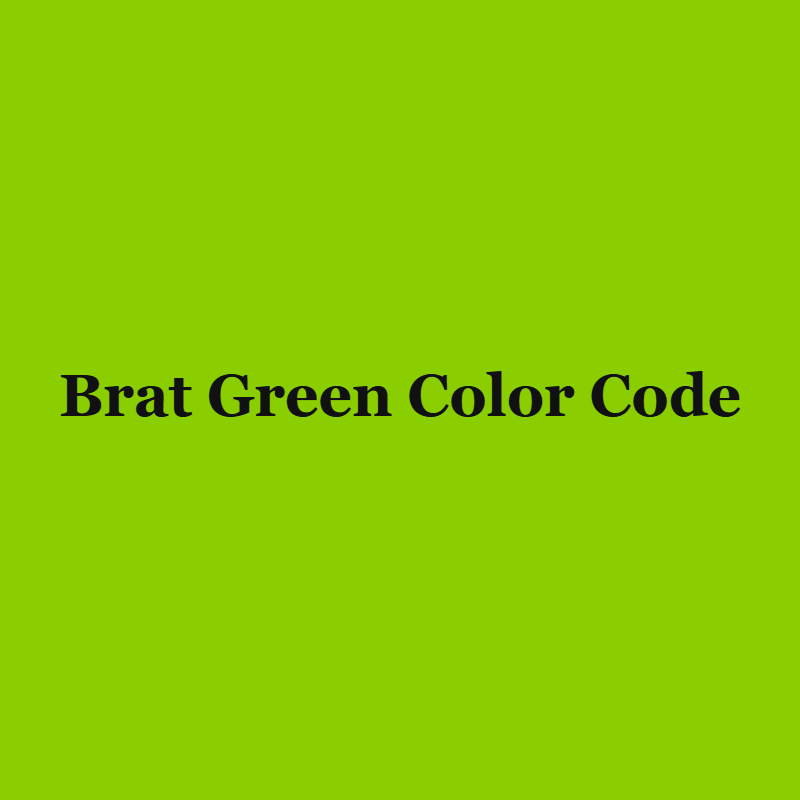
So let’s settle it properly. The color code behind the viral neon-green aesthetic that took over feeds in 2024 is #8ACE00. That’s the number you want copied into your clipboard right now if you’re building a design, a thumbnail, or a website background. Everything below explains where that number comes from, how it converts across color formats, and how to actually use it well — not just paste it and hope.
What Exactly Is Brat Green?
Brat green is the near-fluorescent yellow-green shade that became the visual signature of a minimalist, lowercase, no-frills design trend in mid-2024. A plain background in this color, paired with basic black lowercase text, was enough to signal a specific cultural moment — deliberately unpolished, a little chaotic, and instantly recognizable at thumbnail size, which is exactly why it spread so fast on TikTok and Instagram.
The color itself isn’t new or invented from scratch. It sits in the yellow-green family alongside chartreuse and lime, but it’s more saturated and slightly more acidic than either of those standard shades. That extra punch is what makes it readable and “loud” even in a tiny profile picture or a busy feed.
The Official Brat Green Color Code
Here are the values you’ll need, gathered in one place so you don’t have to dig through five browser tabs.
| Format | Value |
|---|---|
| HEX | #8ACE00 |
| RGB | 138, 206, 0 |
| CMYK | 33, 0, 100, 19 |
| HSL | 80°, 100%, 40% |
| HSV/HSB | 80°, 100%, 81% |
| Closest Pantone | 3507 C (approximate print match) |
If your software only accepts one input, hex is your safest bet — #8ACE00 is the version that shows up most consistently across design tools, browser extensions, and color-matching guides.
Brat Green Hex Code
The hex code #8ACE00 breaks down into three pairs: 8A (red channel), CE (green channel), and 00 (blue channel). Converting that to decimal gives you the RGB values below, which is really the same color described in a different language.
Paste #8ACE00 into any hex field — Canva, Figma, Photoshop, CSS, PowerPoint — and you’ll get an identical result every time, because hex is a fixed, unambiguous format. That consistency is exactly why hex has become the default reference point whenever people talk about this shade, more so than RGB or CMYK.
Brat Green RGB Code
In RGB, brat green translates to 138, 206, 0. Breaking that down:
- Red sits at 138 out of 255 — moderate, not dominant
- Green sits at 206 out of 255 — the driving channel, high but not maxed out
- Blue sits at 0 — completely absent
That zero-blue value is a big part of why the color reads as “acidic” or slightly unnatural. Most greens found in nature carry a trace of blue; stripping it out entirely is what gives brat green its synthetic, almost warning-label intensity.
Use RGB values when you’re working in code (CSS rgb(138, 206, 0)), video editing software, or any tool where hex isn’t accepted directly.
Brat Green CMYK Code
For print work — posters, merch, packaging — you’ll need CMYK: 33, 0, 100, 19. That reads as 33% cyan, 0% magenta, 100% yellow, and 19% black (key).
A quick word of caution here, because this is where a lot of print projects go wrong: CMYK is not a fixed translation of hex the way RGB is. The exact result depends on your printer, the paper stock, and the color profile in use. Treat 33, 0, 100, 19 as a strong starting point, but always request a physical proof before running a full print job. I’ve seen brat green come back looking noticeably more yellow or noticeably duller depending on the press — it’s one of the more printer-sensitive shades because of how saturated and blue-free it is.
Brat Green HSL Value
In HSL terms, brat green sits at 80°, 100%, 40%. The 80-degree hue places it firmly in yellow-green territory on the color wheel (0° is red, 120° is pure green, 60° is yellow). The 100% saturation confirms there’s no dulling or graying in the color — it’s as vivid as that hue allows. Lightness at 40% keeps it darker than a pale lime, which is part of why it photographs and screenshots so well without blowing out.
HSL is especially handy if you want to build a palette of related tones — shifting lightness up or down while keeping hue and saturation locked gives you consistent variations for hover states, gradients, or shading.
Brat Green Pantone Code
For brand guidelines or professional print jobs, the closest Pantone match is generally cited as Pantone 3507 C. Keep in mind this is an approximation, not an official designation — Pantone matching is done by eye and by swatch book comparison, and different print shops or design references may land on a slightly different neighboring Pantone number. If a client or printer needs an exact Pantone spec, get a physical swatch book comparison rather than trusting any single online source, including this one.
Brat Album Cover Color Code — Where the Trend Started
The reason this shade has a name and a cultural identity at all traces back to a 2024 album cover: a plain green background with a single word in lowercase, deliberately blurry Arial-style type, and nothing else competing for attention. That stripped-down look was designed to feel intentionally low-effort — almost like a placeholder image rather than polished cover art — and that anti-polish quality is exactly what made it so easy to imitate and remix.
Worth noting for anyone building a commercial project: a specific piece of album artwork is copyrighted, and recreating the exact cover — the specific typography, layout, and branding — can raise trademark and copyright concerns if you’re using it commercially. The color value itself, #8ACE00, is just a number describing a point in color space; color codes aren’t copyrightable. But “the color is free to use” and “recreating someone else’s cover design is free to use” are two very different claims, and it’s worth keeping that distinction in mind if your project is for a paying client or a public brand.
Brat Green vs. Similar Shades
People often confuse brat green with standard lime green or chartreuse, so here’s how they actually differ side by side:
- Lime green (#32CD32) — more balanced between yellow and green, softer overall, commonly seen in sports branding
- Chartreuse (#7FFF00) — sits closer to pure yellow, brighter and less “green” than brat green
- Brat green (#8ACE00) — more saturated and slightly more yellow-leaning than standard lime, giving it a bolder, more aggressive presence on screen
Side by side, brat green reads as punchier and slightly dirtier than chartreuse, and more intense than typical lime green. That subtle difference is exactly why substituting a “close enough” green rarely fools anyone who’s seen the original — the eye picks up on saturation differences faster than most people expect.
How to Use the Brat Green Color Code in Design Tools
Canva: Open your background or shape color picker, click the hex field, and type 8ACE00. Canva will auto-add the # symbol.
Photoshop: Open the color picker (foreground or background swatch), type 8ACE00 into the hex field at the bottom, and hit enter.
Figma: Select any fill, click the hex input in the right-hand panel, and paste 8ACE00.
CSS/Web design: Use background-color: #8ACE00; or the RGB equivalent rgb(138, 206, 0). Both render identically in every modern browser.
PowerPoint/Google Slides: These tools sometimes want the hex code without the # symbol — just 8ACE00 — so remove it if the field rejects your input.
A tip that’s easy to overlook: if your final design feels overwhelming or hard to read, it’s usually not the green that’s the problem — it’s the contrast. Pure black text on #8ACE00 gives you maximum legibility. Off-white or cream text softens the intensity slightly while keeping strong contrast. Avoid mid-tone grays or other muted colors on top of this background; they tend to disappear against a shade this saturated.
Common Mistakes When Recreating Brat Green
- Eyeballing the color from a screenshot. Compression and screen calibration shift the exact tone, sometimes enough to notice side by side. Always start from the hex code, not a sampled screenshot.
- Ignoring color profiles in print. CMYK output varies by printer and paper — always proof before a full run.
- Overcomplicating the palette. The whole appeal of this aesthetic is restraint. Adding gradients, extra colors, or drop shadows undercuts the effect.
- Using the wrong font weight. The color does half the work, but plain, slightly heavy sans-serif type does the other half. A thin or decorative font clashes with the intentionally raw look.
Frequently Asked Questions
What is the exact hex code for brat green?
The hex code is #8ACE00.
Is brat green a real, official color name?
It’s not an official Pantone or web-standard color name — it’s a nickname that stuck after the 2024 trend, describing the specific hex value #8ACE00.
Can I legally use the brat green color code in my own designs?
Yes. A color value on its own isn’t copyrightable. Just be careful about recreating an entire cover design — layout, specific typography, and branding — for commercial use, since that combination can raise separate trademark or copyright questions.
What’s the closest Pantone match to brat green?
Pantone 3507 C is the most commonly cited approximate match, though exact Pantone matching should be confirmed with a physical swatch for professional print work.
Does brat green look the same on every screen?
Not exactly. Screen calibration, brightness settings, and color profiles (sRGB vs. wider gamuts) can shift how saturated or bright it appears, even though the underlying hex value stays fixed.
What font pairs best with brat green?
A plain, slightly bold sans-serif — Arial or Helvetica are the most common choices — in lowercase, with no additional styling.
Final Thought
The lasting appeal of brat green isn’t really about the number #8ACE00 — plenty of greens are technically similar. It’s about restraint: one saturated color, one plain font, zero decoration. That’s a harder design principle to hold onto than it sounds, especially once you’re tempted to add gradients or extra flourishes. If you’re building anything with this shade, the biggest favor you can do your design is leaving it alone once the color and type are locked in. The code gets you the exact match; the discipline to stop there is what actually makes it work.